Friday, 10 June 2011

RANO RARAKU AND ORONGO

FRIDAY 10th JUNE

  I met Paul  Emmerson at breakfast and we decided to have a look at some of the sights close to Hanga Roa, then visit the museum and finally go to the National Parks.  There are quite a few moia in the town and just outside, and we religiously viewed them all.  One of these is dedicated to the seven Polynesian explorers who set out in a canoe and traveled thousands of miles before finding Easter Island, and this at a time when Europeans were afraid of falling off the edge of the world!  These exploerers may have come from the Marquesas Islands and were led by Hotu Matu'a.  Whilst the Ivth century is often mooted as the date for this event, recent investigations suggest that the VII century or even XIIth century are more likely dates for the start of this colonisation.  Within a couple of centuries the population of the island expanded with some rapidity, and they became organised into 10 mata or main groups, in a typical Polynesian way.
                                                            The seven explorers

  For many centuries the religious beliefs of worshiping their ancestors held sway.  These were apparent in the construction of  "ahe"  (raised stone platforms) on which they placed the carved moai. However as with all human races, internal wars developed and over a period of 200 years or so all the moais on the island were toppled over face downards.
  The Rapanui culture had a system of writing that saw lines of symbols carved out on pieces of wood, and each line was upside down to the preceeding one.  The symbols were not a sound, but rather denoted items and objects.  The Peruvian slave invaders in the XIXth century removed virtually all the local natives skilled in the art of reading resulting in this written language dying.  Allied to diseases brought in by Europeans, this all resulted in a virtual extermination of the Rapanui people.
  After our initial bout of visits we made our way to the museum, which was a longer walk than we at first anticipated.  Whilst although the displays and plaques were written up in Spanish, we received a booklet with English translations of all that was there, so it was really worthwhile a visit and answered many of the questions that we had in mind.  The first Europeans to make contact with the island landed there on Easter Sunday 1722, hence the name.

 An example of how the eyes were created, but not many of the restored moai have them, probably because they got damaged or lost.
                                            An example of a female moai.

  The two National Parks lie at opposite ends of the Islands and are both volcanic craters that helped form the Island 3 million years ago when Poike or Pua Katiki first errupted and raised itself some 3000m above the sea bed. It remained a small island for about 2 million years,  when Rano Kau did likewise and then Maunga Terevaka followed suit to create the island as it is now.

  Our host, Sergio turned out to be a retired archeologist, closely allied to the restoration of the moai and a man who has lectured at Cambridge University, and pretty fluent English speaker.  I must say that visiting these two parks made it a memorable day, in terms of sightseeing possibly the best of the trip so far, and well worth the 30,000 pesos fee for admitance.  We decided to start of with the Rano Raraku site as it was the furthest away.  Although it was overcast there was no sign of rain and visibility was much better.

  There were two paths leading into the national park.  We were told to take the left had path first then come back down and take the right hand one.  The initial path led into the volcano crater.
 Returning from the crater and taking the right hand path takes you around the outside of the volcano past the largest conglomoration of moais on Easter Island.
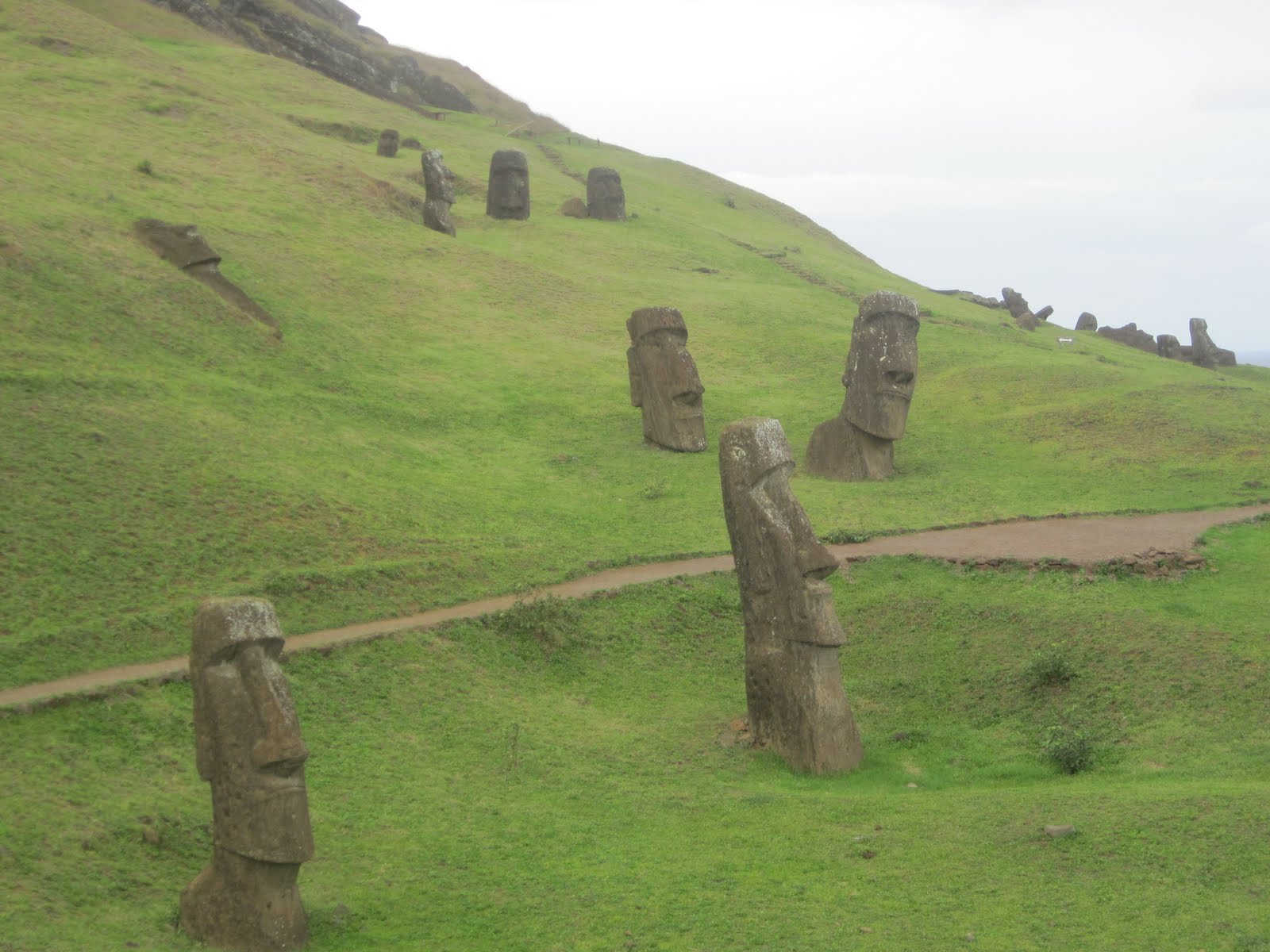
Paul catching the moais for posterity on his camera!
 Paul wanders up to take a picture of an unfinished moai carving in the side of the volcano.
 A view of the Anakena ahe and moais from the side of Rano Raraku.

After completing our survey of the area we drove the 24Km of the southern coast road to Orongo.  This inolved a journey along a dire stone/dirt road climbing to the top of Rano Kau volcano.  The sight here was even more spectacular than at the previos sight as the volcano is virtually situated on the edge of the sea.
Just a bit further down is Orongo ceremonial village consisting of 54 houses.  It was used for only a short time each year in early spring and relates to the Make-Make cult which replaced the Moai tradition.  The village was however built before this cult took hold, probably from about the end of XVI century.
 You could only crawl in through the front doors!  Apparently there was a lot of of trouble between neighbours.  Some were a bit rowdy!
   Each faction selected their own competitor in the tangata-manu event, and their task was to scramble down the rocks swim the mile or so to the isle of Motu Nui and there await the first egg of the "manutara"  - Sooty Tern seabird that flew in each spring to nest on the islet.  The village of Orongo was meantime populated by people from all over the island and various events were organised in preparation for this event.  The competitors had to stay on the islet for days, sometimes weeks, and then scramble to get hold of the egg ahead of the others, and safely get back unbroken to Orongo.  The last such competition took place in 1867.
The winner became the known as the tangata-manu or birdman.  He or his chief received the award and was acknowledged as the leader for a year. He was considered sacred and lived alone with a priest in ceremonial reclusion.  He was not allowed to cut his hair and only the priest could wash him.  He also could not be seen by all lesser mortals during his year in office.
We managed to do the final circuit on the island just before it got dark, but it was the least interesting one and consisted of several caves which we did not enter.  After a breather at the hotel we nipped up the road for dinner and both had tuna washed down by Pisco Sours and beer.  Of the list of ten songs I picked for the trip, Paul managed to find all but two, Johnny Restivo's The Shape I'm In and the Rolling Stones It's All Over Now.
 These circular constructions related to some children's game, but quite what their significance was eluded me.

Thursday, 9 June 2011

RAPA NUI - ISLA DE PASCUA

THURSDAY 9th JUNE

  Met Paul at breakfast this morning, he's the chap who was delayed in arriving from Santiago yesterday until 1.00am.  He's in his early 30's works in marketing in China and has taken a 12 month sabbatical to travel around the world.  He expressed willingness to share the cost of a car and explore the island together.  The car hire man turned up at about 9.45am saying I hadn't phoned him last night after speaking to Paul to confirm the hire of the car.  I told him as Paul hadn't arrived until after 1.00am and I hadn't seen him until this morning, that hadn't been feasable.  Anyway I cannot remember any such arrangement being made.  We hired the car and et off for the far reaches of the island.  Apparently the Europeans discovered the island they landed on it on Easter Sunday, hence the name.  The moai statues, of which there 887 when on the island were carved by the Polynesians between 1250 -1500.  The larget weighs some 86 tons! They face inland and represent deified leaders and chiefs.  At the first site we stopped at, Anakena, cows were grazing under the palm trees.  In an amazing feat
of transportation over half of the statues were moved from the main rock quarry at Rano Raraku to various parts of the island.  Sadly despite optimistic forecasts from the locals the weather did not clear, but got progessively worse.  We carried on around the coast and came to Papa Vaka and the stone carvings.
Below is the tallest moai, Paro some 10m tall and weighing some 82 tons, which was toppled face downards.  The toppling started as a result of conflict between tribes on the island commencing in 1722.  By 1868 there wasn't an upright statue left on the island!
  Cuting down southwards we drove towards Rano Raraku whih is one of the national parks and you have to pay $60 US per person to visit.  We mutually agreed that in view of the weather conditions we would give it a miss and carry on along the southern coast road.  Unusually with all the moai, we came across a shrine to Our Lady with baby Jesus in her arms.
 At the point where the road curves around to follow the southern coast, lies the Tongariki site with a large array of moai, 15 in all.  They were destroyed by a huge tidal wave in 1960, but have since been restored.
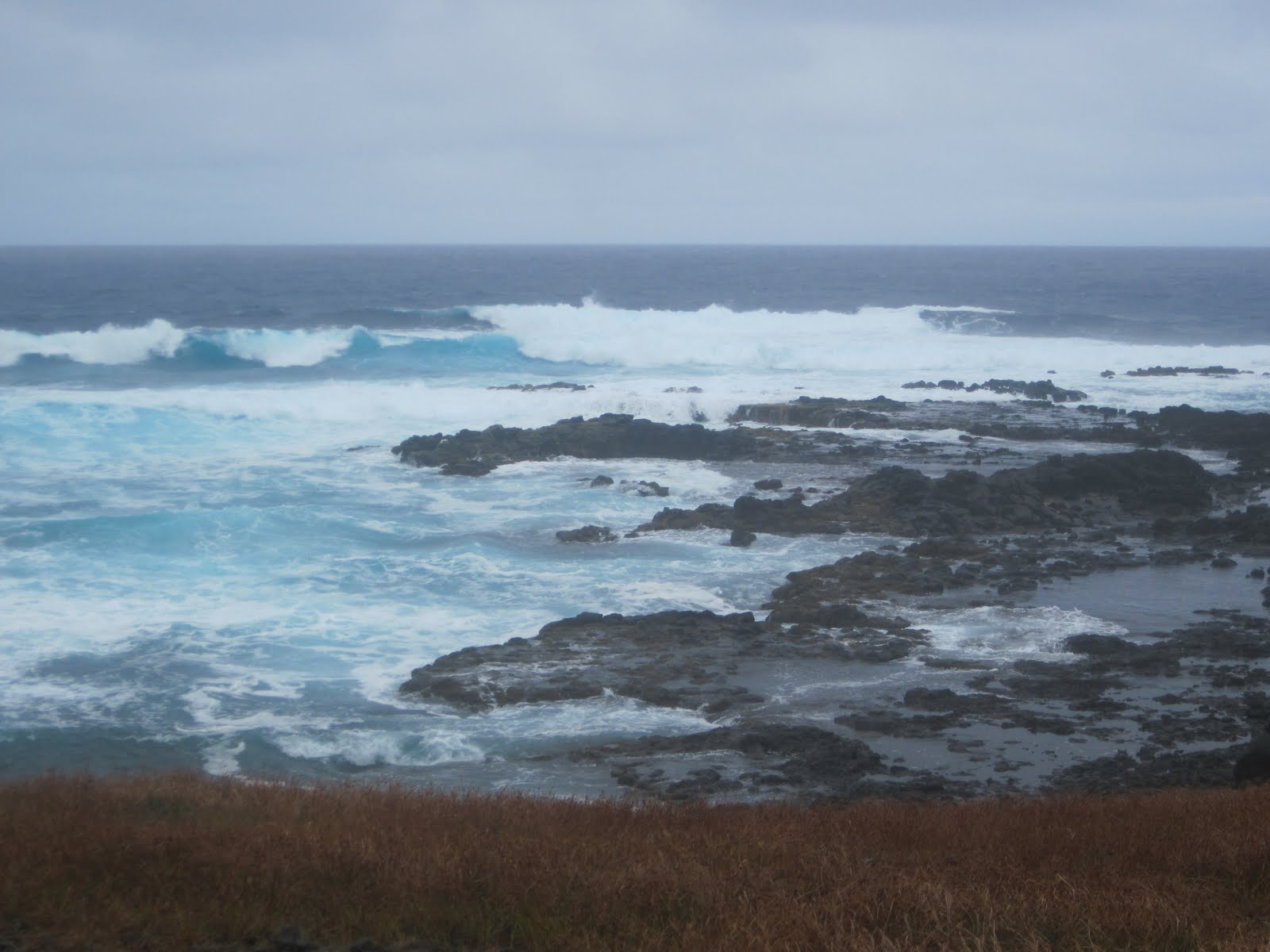
 Further down the coast there were spots with a wonderful array of blues as the sea exerted its force on the shore.
A bit further down the coast I made a closer acquaintance with a solitary moai.  Amazingly at this point it had briefly stopped raining!
Eventually we returned to Hanga Roa and observed the horses roaming around the sea shore as well as the waves continuing to batter the shore line.
We were in time to catch a late lunch at one of the restaurants and sample a beer before going off to look for postcards.  So keep a look out in the post in about a week's time, Nick, Shauna, James and Leia, there might be something coming your way!
Paul and I went out to dinner about 8.30pm and had our first Pisco Sours - in fact a couple each, before going on to sample the local beers.  We both had local fish mine done with cocanut and tandoori sauce along with "Smushed sweet potato".  It was all really excellent.  Paul got me to chose my top ten all time songs.  A very pleasant evening and a fine end to an interesting day.

Wednesday, 8 June 2011

HOPPING OVER TO EASTER ISLAND

WEDNESDAY 8th JUNE

  Well I couldn't get to sleep at all last night, my mind was full of  "what ifs" which weren't conducive to nodding off.  I noticed my ticket stated baggage limit was 23Kg whereas on the BA/Qantas flights it was 2x23Kg.  Would I have problems with the weight?  I had spread it over two bags, but who knows.  I decided to get up at 4.00am and work on the computer until it was time to go.  I got up to go to the bathroom about 1.30am and the next thing I knew the alarm was going off!  Thank gawd it worked as I was sparko!  I made some coffee checked my e-mail, and Robert rang on Skype!  Apparently it was 7.30pm with him, albeit 5.00am here - he picked the right day to phone.  I thanked him for the efforts in contacting the hotels regarding transport. I was making my way downstairs as 6.00am struck.  The reception was in darkness.  I went to the front door - it was locked!  Shite!  How was I going to get out.  I rattled the door, and I suddenly heard some noise - it was the receptionist waking in his chair!  I waited awhile, but no sign of Louis.  I kind of communicated with the receptionist who phoned Louis.  Apparently he thought he was due at 6.30am - I reckon he just slept in.  He arrived about 6.20am and told me he would get me to the airport in 20 minutes.  As my flight was 8.20am I wasn't panicking yet.

  The domestic terminal was absolutely heaving, and I couldn't see any check-in desks stating "Isla de Paqua".  I found A LAN desk and asked where to check-in.  They didn't seem to be sure and suggested that I ask one of their colleages by the check-ins.  I made my way over to the this young lady and showed her my ricket.  She took me to a self service check-in machine, printed out my boarding card and then directed me to desk 54.  Now for the weight problem I thought.  But no, I was checked in and directed which way to go.
I had a cup of coffee airside to celebrate.  When I boarded the plane I found I was right at the back but in the central seat of three.  A big fat tatooed bloke sat on my left and a much smaller bloke on my right.  My back immediately took exception to the seats and pained me for the entite 5 hours of the flight.

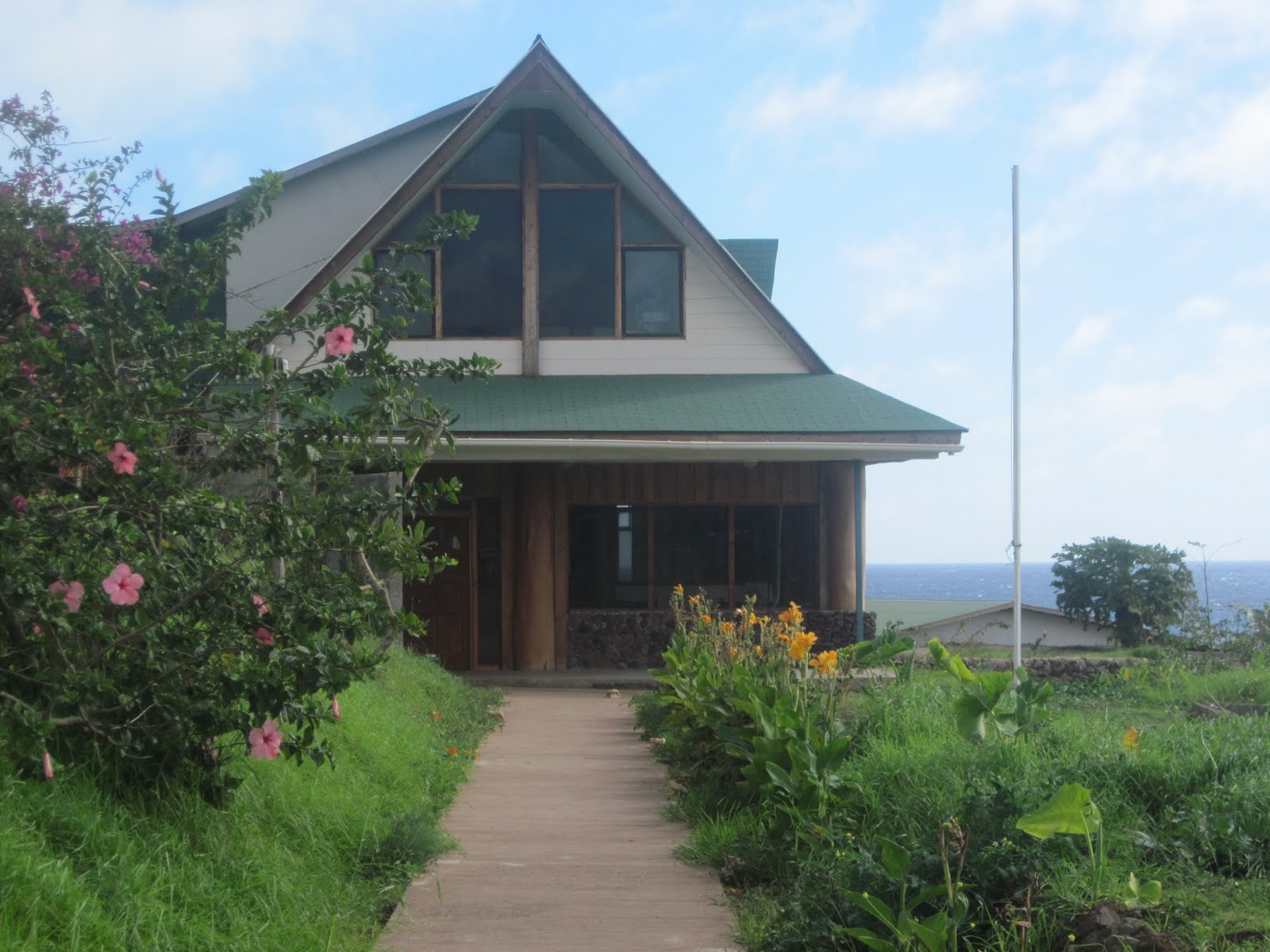
  My bags turned up pretty quickly and I strode out of the tiny terminal and sure enough there was a card stating "Adam Komorowski".  I made myself known to the man who is a retired archeologist, married to an American lady with a son living in the States.  He spoke excellent English, and drove me to Tupa Hotel, about 5 minutes from the airport.  It overlooks the sea. The weather was far too warm for my t-shirt plus fleece shirt and I quickly changed into shorts and a short sleeved shirt.  I had checked in, paid my money upfront in cash, and was delighted to see that although credit cards hadn't reached the Tupa Hotel, free WiFi had. My man Sergio then drove me around the town,
which has one main street and a few side streets, where all the restaurants are to be found.  He dropped me off at one where I had an excellent meal washed down by a beer.  Next door is the car hire place recommended by Sergio, he reckons a much better way of seeing the Island than going on a tour that only lasts 4 hours and is conducted by his former students - some of whom "are not so good".  I've arranged for a small jeep which will cost me $60 - but there may be an English chap arriving on the evening flight and Sergio said he might like to share - well see.

  I walked down to the shore and then back to the hotel taking in the sights enroute.
  After getting back I found I was a bit drowsy what with the beer and that, and decided on a bit of a siesta, as I was a bit short on sleep.  After waking up from that it was time to catch up on these blogs.

LAST DAY IN SANTIAGO

TUESDAY 7th JUNE


  Well my stay in Santiago is coming to an end. My first task was to organise a cab for 6.00am tomorrow, hopefully Louis would come.  Unfortunately the English speaking chap who booked me in wasn't around today so I tackled the Spanish speaker at reception.  After some considerable discussion we appeared to reach a satisfactory conclusion.  I went back to my room on the 7th floor and soon received a call asking if I could come down again - or at least that is what I understood it to be.  Upon reach the ground floor again, there was Louis.  I explained again what was wnated, and he went off assuring me he would be there in the morning.

  It was time for my last promenade around Santiago. I strolled up to the Post Office again to post a card to Jeannette having found their address on Google - the house is allegedly still up for hire until you go into it and then it states it is unavailable.  When I got to Plaza de Armas there appeared to be some major student demo in progress with loads of placards, chanting to the beating of drums and the like.  One long placard read; "+$ = better professors = better education"  or at least that is my translation.  Anyway it is a sentiment you can't argue with.
  I found there were still plenty of streets in the centre that I hadn't fully explored, and found one or two interesting buildings in the process, like a red church nothing to do with its political affiliations!).
Then there was some sort of official looking building but I couldn't see any notices on it to say what it was.
And then there was a Chinese Restaurant somewhat incongruous in its setting amidst office blocks!

I found a very pleasant cafe where I had a toasted beef and cheese sandwich and a coffee as well as a read of Ruth Rendell'sThe Keys To The Street, before wandering back to the Infinity.  I came acros the remnants of the student demo in Londres Street and what looked like a water cannon vehicle and the road streaming with water and loads of TV cameras around.
  And speaking of Londres, I found a plaque outside no 36 that seemed to suggest that this was a place of torture in the '70s and indeed among the cobble stones on the adjoining street there were small metal plaques with names and ages , I assumed of people who had suffered there or maybe even died.  It is believed that, following the 1973 coup by General Pinochet, which deposed President Allende, there were some
3000 people killed and a 1000 of these have been listed as the "disappeared", who vanished under the rule of General Pinochet.  Some it has turned out had their bodies thrown in the Pacific Ocean like Communist offcial Victor Diaz.

  Upon my return I packed all my belongings and retired early, worrying lest the alarm clock didn't go off.  I had trialed it the previous night but then had difficulties turning the alarm off, and wasn't sure if I had turned it off permanently.  My mobile, which is set on NZ time refuses to be adjusted, and although i tried the alarm on that it didn't seem to work, so here's hoping the body clock will do its work if necessary.